グローバル教育〔 地球的規模で考える 〕
留学レポート
ドイツ留学レポート⑤
Froes Neues Jahr!
Happy New Year!
It has been snowing for the past two weeks, and the roads have become very slippery. I even fell off my bicycle, and the same thing happened to some of my friends.
Over the past month, I have had many enjoyable and memorable experiences.
First of all, I started living with a new host family in December, with whom I talked a lot and played various games. Before Christmas, I attended several Christmas concerts. In addition, I performed on the piano at the school concert, which was a particularly meaningful experience for me. Although I do not have music class at school, the music teacher suggested that I play,
During Christmas and New Year's Eve, my host family and I stayed on Norderney, an island in the North Sea. Although the weather was extremely cold and windy, the stay was very special, as I was able to relax inside the house and learn a lot. I watched Christmas films, as well as Ghibli films. Also there were a lot of rabbits on the island.
At Christmas, we decorated the Christmas tree, which was real and very tall. I also made a gingerbread house with my host sister and brother and decorated it with Haribo gummies. Furthermore, we played many card and board games. One of them was a card game called Ligretto, which I had already played with my German teacher in Japan, and I highly recommend it. My host sister performed the poem called "Der Zauberlehring" by Goethe. It is a very fun and beautiful poem about a wizard preparing a bathtub. We received our presents on the 24th of December. For dinner, we had raclette(heating cheese with grilled vegetables, mushrooms etc.), which is a traditional and popular meal during the Christmas season in Germany.
Moreover, we celebrated Silvester (New Year's Eve). In Japan, the first day of January is particularly important and is usually spent with family members. In contrast, New Year's Eve plays a more significant role in Germany, and it is not a family event. We set off fireworks, which I found scarier than those in Japan because they were much larger. My host family explained to me that fireworks are extremely popular on Silvester; however, due to the high number of accidents, they have increasingly become a social issue in Germany.
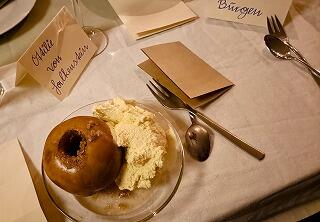
At the end of the Christmas holidays, some friends invited me to a birthday party. The theme of the party was a mystery dinner. Each guest had a role, such as a queen, a prince, or a servant. My role was Ottilie von Falkenstein, a servant of the princess. While having dinner, we had to speak according to our characters and the given situation and guess who had murdered the king. The idea of a mystery dinner was completely new to me, and I enjoyed it very much.
My internship at the university will start this week. As this will be my first internship, I am looking forward to gaining insight into the job and reflecting on my future plans, especially regarding what I really would like to study at university.
Tschüss!
Moin!
Last month, I completed a two-week internship. Every student in our year is required to complete an internship, and we must apply independently to workplaces that interest us. Many students gained experience in a wide range of fields. Many of my classmates chose hospitals, while others worked in a bookstore, a theatre, a musical instrument manufacturing company, or an IT firm.
For my internship, I had the opportunity to work at the university in Bremen, which is about 35 minutes from Oldenburg by train. Commuting daily was already a valuable experience, as it helped me become more confident using public transport in Germany.
During my internship, I attended three different levels of Japanese language courses. It was fascinating to observe the differences between university-level Japanese classes and those at a Gymnasium. My responsibilities included taking attendance in Japanese and grading vocabulary tests. In addition, one of the teachers lent me a teaching manual that she uses for her classes. After reading it, I was impressed by the variety of teaching methods explained in the book and how systematically they were applied in her lessons.
The teacher herself is Japanese, and I found it particularly interesting to hear her perspective as a Japanese educator living abroad. She shared many insights about her profession and explained what she values most in her teaching. For example, she places great emphasis on students writing their own original sentences. This method allows students to actively use new vocabulary and express their own thoughts, which makes language learning both effective and engaging.
Upon completing the internship, I was required to submit a written report on digitalization at the university and in the field of Japanese language education. Writing this report was quite challenging for me, as it was my first time writing a report in German. Nevertheless, I am very happy that I was finally able to complete it this week.
Overall, I am very grateful to the teacher for supporting me and for giving me this opportunity at the university. This internship provided me with valuable insights and has given me inspiration for my future career path.
Ciao!
Moin!
今日は、ドイツの面白い一面をご紹介したいと思います。それは、ドイツ鉄道(Deutsche Bahn)についてです。
今年に入ってから、インターンシップや休暇中のベルリン旅行などで電車を利用する機会が多くありました。その中で、日本との違いをいくつも実感しました。
まず、ドイツには日本のような改札口がありません。車内で係員が切符を確認しに来ることはありますが、毎回とは限りません。
また、ドイツの電車は遅延が多いことで知られていますが、私が特に驚いたのは電車のキャンセルが珍しくないという点です。さらに、発着ホームの変更も頻繁に起こります。ホストマザーによると、ドイツ各地で駅の改修工事が進められていることが、その一因だそうです。
インターンシップ期間中も遅延やキャンセルを何度も経験しましたが、特に印象に残っているのはベルリン旅行の帰り道です。ベルリンからオルデンブルクまでは、ハノーファー経由で通常約4時間かかります。しかし、その日はハノーファー行きの電車が走行中に線路上で突然停止してしまいました。車内アナウンスによると、電力供給が停止したため運行不能になったとのことでした。
やがて車内の照明も消え、暖房も止まりました。約3時間そのまま待機した後、ようやく代替列車が到着しました。乗客ははしごを使って移動し、代替列車へと乗り換えました。
その後、無事にハノーファーへ到着し、オルデンブルク行きに乗り換えましたが、その列車も約1時間半遅延しました。結果的に、帰宅までに9時間を要する長旅となりました。
そのような状況にもかかわらず、車内アナウンスは「列車は停止いたしましたが、皆さまが良い旅を過ごされていることを願っております」といった前向きな内容で、思わず苦笑してしまいました。
Tschüss!
Moin!
Today, I would like to introduce an interesting aspect of Germany: its railway system, Deutsche Bahn.
Since the beginning of this year, I have had many opportunities to use trains, including for my internship and a trip to Berlin during the holidays. Through these experiences, I noticed several differences compared to Japan.
First, unlike in Japan, there are no ticket gates in Germany. Staff members occasionally come to check tickets while the train is in motion, but they do not come every time.
German trains are well known for frequent delays, but what surprised me even more was that train cancellations are not uncommon. Changes in departure platforms also happen quite often. According to my host mother, this is partly because renovation work is currently being carried out at stations throughout Germany.
During my internship, I frequently experienced delays and cancellations. However, what left the strongest impression on me was my return trip from Berlin. Normally, it takes about four hours to travel from Berlin to Oldenburg via Hanover. However, the train to Hanover suddenly stopped on the tracks while in motion. According to the announcement, the train had lost power and was unable to continue operating.
Gradually, the lights inside the train went out, and the heating stopped working. After waiting for about three hours in the stationary train, a replacement train finally arrived. All passengers had to cross over using a ladder to evacuate to the replacement train.
After that, we safely arrived in Hanover and transferred to a train bound for Oldenburg. However, that train was also delayed by about an hour and a half. In the end, what should have been a four-hour journey turned into a nine-hour train trip.
Despite the situation, the onboard announcement remained surprisingly positive, saying something along the lines of, "Although the train has stopped, we hope you are having a pleasant journey." I found this both amusing and memorable.
Tschüss!